For machinists and those working with threading tools, understanding the various types of thread taps and their appropriate usage is a critical skill. This comprehensive guide dives into the different types of thread taps and how to use them to provide invaluable insights for both beginners and seasoned professionals. Knowledge is your best defense against threading errors and tool damage, so let’s delve into the world of thread taps.
What Are Thread Taps?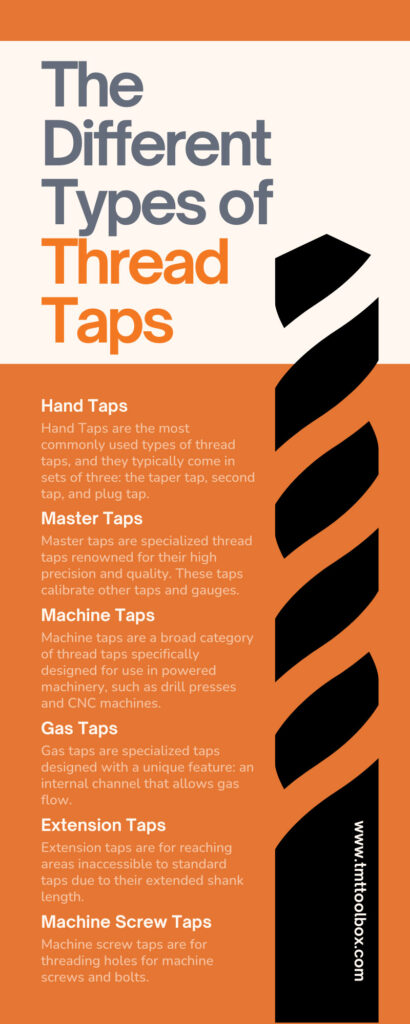
Thread taps are tools in the machining industry that you can use to cut or form threads on the inside surface of holes, enabling you to insert screws or bolts. They come in various shapes and sizes, each designed for specific uses and materials. The process of using a tap to create threads is called tapping, an essential operation in manufacturing where threaded holes are necessary. For professionals in the machining field, understanding thread taps and their appropriate applications is crucial for ensuring accuracy, maintaining tool longevity, and preventing costly mistakes.
Hand Taps
Hand Taps are the most commonly used types of thread taps, and they typically come in sets of three: the taper tap, second tap, and plug tap. Each tap has a specific purpose and use. With its longer taper, machinists use the taper tap initially to cut out most of the material and start the threading process.
Next in the threading process is the second tap. It has a shorter taper and cuts deeper into the material, providing more precise threads.
The plug tap, with the least taper, is the last one you’ll use to finish the threading process, ensuring the threads run the entire length of the hole.
You typically turn hand taps with a tap wrench, and you must use cutting fluid to reduce friction and prolong the life of the tap. Hand taps, being manual tools, allow greater control and are thus common in delicate operations where precision is paramount.
Master Taps
Master taps are specialized thread taps renowned for their high precision and quality. These taps calibrate other taps and gauges, hence their name. Their design matches an exacting standard, boasting impeccable accuracy in their thread profiles, which makes them perfect for verifying the correctness of other tools. Given their precision-oriented role, master taps often contain high-quality, durable materials to withstand wear and tear while maintaining their dimensional stability.
When using a master tap, you must ensure the tool in question matches the master tap’s thread pitch and profile. With careful handling and correct usage, master taps can serve as reliable benchmarks in a machinist’s toolbox for maintaining the accuracy and consistency of threading operations.
Machine Taps
Machine taps are a broad category of thread taps specifically designed for use in powered machinery, such as drill presses and CNC machines. They’re best for large-volume production due to their speed and efficiency. Unlike hand taps that require manual operation, machines drive machine taps, significantly reducing the time and effort required to create threads.
Machine taps come in various styles, depending on the specific application, but they generally feature a more robust construction to withstand the higher stress of machine operation. Common types include spiral point taps, designed to push chips ahead of the cutting action, and spiral flute taps, which pull chips out of a hole.
When using machine taps, you must match the tap speed to the material you’re tapping and use the appropriate coolant for heat management. Machine taps offer machinists a rapid and efficient solution for high-volume threading tasks.
Gas Taps
Gas taps are specialized taps designed with a unique feature: an internal channel that allows gas flow. This makes them essential in industries such as plumbing and heating systems. These taps often contain sturdy materials like brass to withstand high pressures and temperatures. Gas taps, named for their specific use rather than a threading mechanism, might employ any of the standard thread types depending on their application. The main element distinguishing them is their ability to control the flow of gas when coupled with a valve.
When using a gas tap, you need to ensure a seamless connection with no leaks, given the potential hazards associated with gas leaks. You also need to partake in regular maintenance to keep the valves in working condition. In essence, while serving a different purpose from those primarily meant for creating threads, gas taps still play a vital role in specific industrial applications.
Extension Taps
As the name suggests, extension taps are for reaching areas inaccessible to standard taps due to their extended shank length. These taps are for threading deep holes or hard-to-reach places, a common requirement in automotive and aviation industries. The key distinguishing feature of an extension tap is its long, slender shank beyond the thread, which allows it to create threads deeper into a workpiece than a standard tap can reach.
When using an extension tap, you must align the tap correctly with the hole to avoid off-angle threading or damaging the tap. Additionally, due to the extended length and potential for flexing, we recommend applying steady, even pressure and using a suitable cutting fluid. Remember, you must take care when withdrawing the tap to avoid causing damage to the newly cut threads.
Machine Screw Taps
Machine screw taps are for threading holes for machine screws and bolts. These taps have fine threads and are for threading into metals, although they can also be for hard plastics or wood. The threading process involves the tap cutting into the material, creating a spiral groove that will accommodate a machine screw or bolt.
Machine screw taps typically contain high-speed steel (HSS) or solid carbide for strength and durability. Manufacturers often coat them with materials like titanium nitride to provide greater resistance to wear. They come in a variety of sizes, denoted by the specific machine screw size they must accommodate.
When using a machine screw tap, ensure that the pre-drilled hole is of the correct size for the intended screw or bolt. Also, use a suitable cutting fluid to minimize friction and heat buildup. This type of tap is a vital tool for any machinist working with machinery assembly or metal fabrication, providing a reliable method of creating accurate, finely-threaded holes for machine screws.
Now that you have a guide on different types of thread taps, you can better understand which type you will need for your machining work. Check out TMT Toolbox’s diverse selection of thread taps today. Remember, the correct application of these tools ensures the quality of your work and the longevity of your tools.